Tuesday, August 31, 2010

Gauging Examination Grading

Every week so far has brought a new experience, whether it be cultural or educational.  The new experience last week involved grading mock examinations for the students in Forms 2 and 4.  First, to give a bit of background, at the end of Forms 2, 4 and 6 students take a national examination on each subject that they are studying.  These exams weigh very heavily on their final grades (about 50%), and usually determine the course of their educational future.

While at most schools the students only take the final national exam (given in the Fall for Forms 2 and 4, and in the spring for Form 6), at Mzumbe (and some other schools) students are given a “gauging” exam- sort of like a mock exam so that the teachers and the students can gauge their progress and what subjects they need to brush up on for the final exam.  Starting last week, the entire faculty gathered together in the library to mark the gauging exams for the students at Mzumbe, as well as other schools in the Morogoro region.  In groups, each department (English, Kiswahili, Geography, Math, Science, etc) graded the tests for their respective subjects.
The Mzumbe Faculty Grading Exams in the School Library

Each day of week was long (about 10 hrs of grading exams each day), but I thoroughly enjoyed the experience.  I was more than happy to be included in the process and contribute in any way possible.  Also, it was a fascinating glimpse into what the national exams for English Language are like, and how the faculty judges a student’s ability in English.  I understand that English is a second (or third) language for some of the students, so I was willing to be a bit more flexible on certain mistakes.  However, the rest of the department was not as lenient, demanding perfection from each student on their respective exam.  Mzumbe, being one of the top schools in the nation, demands nothing less than the best from its students.

The English Department Hard at Work
The week was also a great opportunity to further bond with the faculty.  There were many laughs, stories exchanged, and debate about teaching the subject of English.  One other interesting thing that I’m starting to notice is that as I listen to more conversations in Kiswahili and increase my own vocabulary, I’m finding that I’m beginning to understand certain sentences, or even the topic of some conversations.  I’m still a long way away from full comprehension of the language, but it’s encouraging to know that some of it is starting to stick!  By the end of the week, I felt that I learned a lot about my fellow teachers and also more about the educational system of Tanzania.  To most of my other colleagues it probably wasn’t a task they enjoyed, but I appreciated the experience as one of many past and yet to come.


Saturday, August 28, 2010

Ultimate Tanzanian Frisbee


In one of the more fun cultural exchanges so far, the other afternoon I had the pleasure of demonstrating a new sport to a few of the students and teachers- Ultimate Frisbee.  One of the items I threw into my bag before I left was a bright yellow Frisbee with a smiley face on it.  I figured it might be something that could be fun to show the students here, and today I was really happy I brought it.

As I am in the staff room most days getting to know my fellow teachers and colleagues, we usually do a lot of sharing about our respective cultures on many topics.  Being a big sports fan, I love to explain to them American sports like Baseball, Basketball and American Football.  They can be complicated to explain sometimes, but my fellow teachers are always interested to learn about what’s popular in America.  This morning I asked a colleague and friend if he knew about Frisbee, and he responded he had never heard of it.  So I told him to come by my house in the afternoon and I would show him.  He came by later on and we went to the field nearby where I showed him how to throw and catch a Frisbee.  Of course there were some students nearby, and immediately they were curious and wanted to join in.  I was more than happy to have them join so I could show them the new sport.  As more and more students came by, I decided I would show them Ultimate Frisbee, a competitive team sport using the disc.  I explained to them the simple rules that they picked up very quickly and then we established the playing field and divided into teams.

Playing the game and teaching the students how to play was a total blast.  Everyone had a great time and was really getting into the fun and competitiveness of the game.  I was amazed at how quickly they picked up the new sport, and got quite a thrill at how much they were enjoying it. 

It was a really cool and rewarding moment because whereas I’ve been mostly taking part in and learning about the culture here, it was one of the first times when I got to share a bit about myself and my culture in a way that was different from just talking about it.  It was a true cultural exchange.  Who knows, maybe the sport will catch on and become a new Tanzanian craze!

Wednesday, August 25, 2010

Teaching At Mzumbe

Form V HGL Classroom


Now that I’m a bit more settled in the community, at my home and at my school here at Mzumbe, I wanted to share a little bit more about the class I’m actually teaching.  First, I should explain a little bit about the way that the school system works here in Tanzania, especially for secondary education.  After completing 7 years of primary school, students will usually begin secondary school at what is called the O, or Ordinary, Level.  I say usually because the government does not pay for secondary school, so not every student starts secondary school right after completing primary school.  Students at the O-Level will complete 4 years (also called “Forms”) studying typical subjects such as science, math, English, geography, and history.  At the end of Form 4 they take a National examination based upon all of the subjects they have taken.  From there, students can elect a number of options (depending on their marks on the national exam), including going to technical school, teacher training school, or continue on to what is called A, or Advanced Level studies.  This is essentially two additional years of secondary education for students who intend to go on to study at a college or university (sort of like Jr. College).  Usually A-Level is broken up into “streams” or “combinations,” each having a specific focus.  For example, if you want to go on a path to becoming a doctor, you would take a combination called PCB (Physics, Chemistry, Biology).  These are the only subjects you would take at the A-Level.  There are many combinations that include subjects such as History, Geography, Mathematics, Economics, and English.  At Mzumbe, the A-Level streams are HGL (History, Geography, English Language) which is considered an Arts stream, PCM (Physics, Chemistry, Math), and PCB, which are science streams.

At the moment, what I have been assigned to teach here at Mzumbe is English Literature for A-Level Form 5.  This is part of the HGL stream for the A-Level.  There are 31 students in my class (an average number for a class in Tanzanian secondary school).  As they are taking the HGL stream for their studies, most of the students are interested in going to Law school, becoming teachers or working for the government in some capacity.  The classroom is a bit small, but comfortable enough for the students to have their own study space, as opposed to some classrooms where students may have to share desks and even chairs.  The students also remain in the same classroom for the entire day, and the teachers will rotate from class to class, as opposed to the U.S. where a teacher will have their own classroom and the students will change classes from period to period.  Each period is 80 minutes, and usually the students will have 4-5 80 min periods each day.  In O-Level, sometimes the periods are 40 minutes.

While the subjects themselves maybe similar in Tanzania as they are in the U.S. the system and guidelines for teachers is also unique, especially for English teachers.  Since there is a uniform syllabus and reading list for the entire country, I have to select specific novels, plays and poetry to discuss with my class.  What is interesting about this from a foreigner’s perspective is a majority of the literature on the list is from African authors.  Since it’s not common in the U.S. to study African literature, I was a bit unfamiliar with a lot of the texts that I found I would have to be teaching, and had to familiarize myself with the books and plays.  While the texts might be different, teaching literature to Tanzanian students is the same as it would for any student in the U.S.  Currently in my class we are discussing one of the novels on the reading list, and analyzing many aspects of the book including characters, themes, figures of speech, etc.  One of the great experiences has been seeing how involved the students get in the discussion of the literature, and how truly perceptive they are about the subject matter.  Every student is eager to participate in discussions and to engage with their teacher and fellow classmates.  They also speak English with ease, so it makes the discussions that much more interesting for me to lead, participate in and observe as well.

At first I was little unsure about teaching English Literature at the A-Level because it wasn’t what I expected to be teaching, and as I mentioned, I was unfamiliar with the texts that I would be teaching.  However, thus far I’ve really enjoyed getting to know my class and teaching them about Literature and how to analyze it and think about it critically.  It’s been very rewarding, and there are many moments when I do truly feel like I’m helping to make an impact on their educational experience.

Wednesday, August 18, 2010

Safari at Mikumi

This past weekend I experienced my first African Safari, as I traveled with two other WorldTeach volunteers to Mikumi National Wildlife Park.  It would be an understatement to say that it was definitely one of the highlights of my time here so far.  We were fortunate enough to see some of the amazing Tanzanian landscape, as well as many many remarkable wild animals up close in their natural environment.


Our Safari Vehicle
On Saturday morning we were picked up bright and early at 6:30 AM in a Safari Land Rover and traveled from Morogoro town to Mikumi National Park, which was only about 60 miles away.  As we entered the border of the park (which is over 3,000 sq km), we immediately spotted a few animals along the road, including some large baboons, impalas and even the occasional giraffe. 


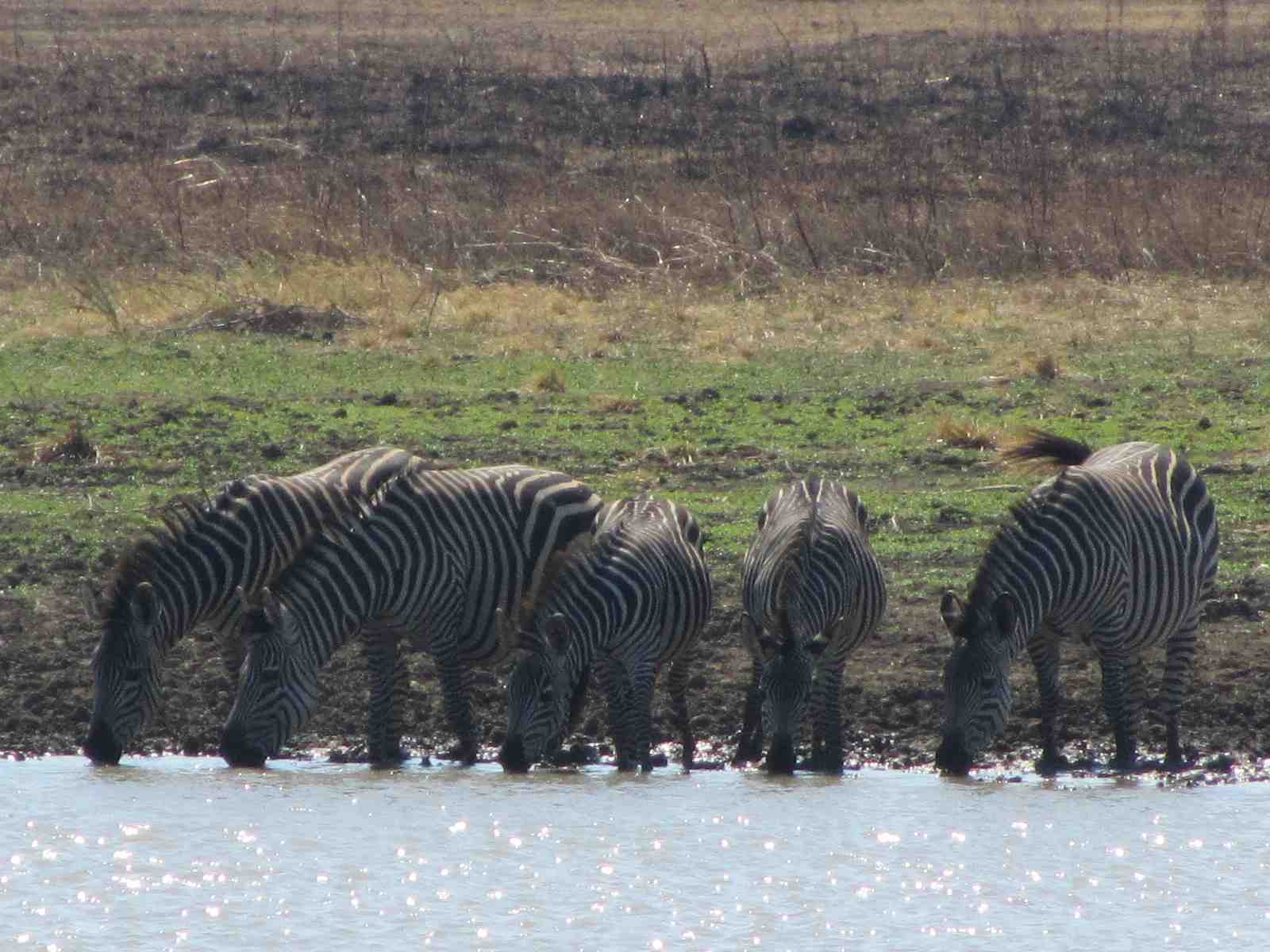
We arrived at the main gate that led into the entrance to the park, and we were greeted by our guide Rashidi, who guided us through the park both Saturday and Sunday.  As we journeyed through the park we saw many animals including zebras, giraffe, elephants, warthogs, water buffalo, hippo, wildebeest and impala.  

Giraffe

Elephants

Wildebeest

Zebras and Impalas

Baboon
Water Buffalo

Hippos

Later in the morning we were fortunate to come across a really amazing find when we saw a female lion and her three cubs feeding on a freshly caught zebra.  Apparently this was rare to see, according to our guide, so we took many pictures and felt fortunate to see such an amazing sight.  It was hard to take my eyes of what we were seeing, and I had to keep reminding myself that this wasn’t a zoo, and we were actually watching these incredible animals as they live in their natural environments.

Mother and her cubs with a fresh kill


Taking a rest and a drink


As the day continued we traveled along the vast roads through the park, and saw many more animals up close and personal.  It was quite serene just driving along the fields and enjoying the landscape.  Besides other safari vehicles, there were no signs of civilization nearby and with the car roof open and the wide open fields and sky it was hard not to feel totally calm, relaxed and at peace.


Once the day finished, we headed to our nearby hotel and got some rest for the next day.  We were picked up bright and early the next morning to head back into the park for some more animal gazing, and we were not disappointed, especially considering all that we got to see the day before.  In the late morning, we were lucky enough to see a male lion resting with two other females in the shade.  Apparently it’s difficult to find a male lion in the park, and people have gone days and weeks without seeing one.  Maybe it was beginner’s luck!

The lions taking a rest

The male lion and his meal


In front of the lion pack


When Sunday evening approached, we left the park, said goodbye to our guide and headed home.  For my first Safari, it was an awe inspiring and truly humbling experience.  It was certainly one of those moments that felt a bit surreal and made me realize how fortunate I am to have this experience in such a remarkable country like Tanzania.


Tuesday, August 10, 2010

Pole Pole


In Tanzania there’s a common saying that’s used in a variety of situations- Pole Pole (pronounced Poe-Lay, Poe-Lay).  It can mean anything from “slowly” to “slow down,” to “calm down,” to “chill out” and anything in between.  It basically is a way to say, “there is no hurry, so why rush.”  It’s also a good way to describe the way of life in Tanzania.  There is no hurry for anything, and people always tend to take their time when doing basically anything.  Coming from the United States, where everyone seems to be in a rush, this has been one of the aspects of Tanzanian life and culture that I’m still getting used to, and even my fellow Tanzanians are noticing.

A good example was the other day I was saying hello to one of the fellow Mzumbe teachers and he said to me, “Mr. Matthew, yesterday I saw you constantly in motion.  You seemed to be very busy.”  I laughed and shook my head a bit and just told him that I probably wasn’t particularly busy, but that it’s just typical American behavior.  He smiled then told me, “In Africa, it’s always Pole Pole.  We work a little, and relax a lot.”  I told him that I’m learning to adjust to that lifestyle, but as everyone knows, old habits tend to die-hard.

It’s funny to think about how in America, even when we’re not busy, we tend to always make ourselves busy.  Here in Tanzania, people enjoy their time, their days, and the company of others as much as they can.  There’s no time like the present, so there’s no rush for anything.  As I’m adjusting to life here, I’m still learning to enjoy each day and each moment as much as I can, even if I’m not busy with “something”.  As they say- Pole Pole.

Student Government Campaigns


Following last week’s Student Government Candidates screening in front of the faculty, on Monday afternoon the entire student body and faculty gathered together in the school assembly hall to hear the candidates publicly campaign for their respective positions in the Student Government.  This was an opportunity for each student candidate to give a speech explaining their reasons for wanting to be elected, as well as take a few questions from their peers.

One by one, each candidate would come up on stage and face their student body, with the faculty watching behind them.  Usually each student would begin their campaign speech by raising their fist and yelling “Determination!” and the student body would follow by yelling back enthusiastically “Is Our Motto!” (Oh, of course I forgot to mention the school motto for Mzumbe is “Determination is our Motto”) Each candidate’s presentation was different, and all of them took their campaign very seriously.  While some were received more enthusiastically than others, each candidate was well prepared and eager and willing to lead their school in any capacity that they could.  You could see the passion that the students had for wanting a responsibility to be a leader in their school.

It was yet another fun and interesting experience to be a part of in my first few weeks at Mzumbe.  I was quite impressed by the level of English that each of the students spoke.  They were all very eloquent and had no trouble speaking in English comfortably.  Also, it was yet another opportunity to hear the views of the students directly and gain an understanding of some of the needs that the school community has.  For me, I was quite interested to hear these points because it gave me a few ideas of how I can personally contribute to the students and the community as a volunteer.  For example, a number of the candidates expressed their disappointment in the operation of the library.  They also mentioned they were hoping to start a school website and also have more opportunities for recreation and sports as well.  These are all areas that I hope that in the near future I can help with.

After today’s general campaign assembly, the students will now vote for their new student body, which will be announced later this week.  It’s been a fascinating process to observe so far, and one that was certainly different from my experience in high school.

Thursday, August 5, 2010

White Men Can't Kick (In Africa)


So far I’ve neglected to mention that there is one word in Swahili that I (and other foreigners) tend to hear quite often as I’m walking around the streets, and even sometimes on the school grounds.  If you’re a foreigner, and more specifically a white foreigner, you are usually referred to by a specific term- Mzungu.  The term literally means “walking in circles” but it’s usually in reference to being a white person, or a foreigner.  Being one of the few white persons in this area, I tend to hear it quite a bit.  However, while it is used in reference to someone based upon their race, it’s not used in a derogatory manner (for the most part).  That can be an awkward thing to understand, being from a very liberal and politically correct country, but it’s just something you come to respect as part of the culture and don’t try to take personally.  After all, it’s not very often that people from other cultures decide to live for long periods of time in Tanzania, so it’s understood that you might tend to stick out a bit from time to time.

This evening, after my run I decided to join the regular soccer match with the other faculty members and students on the field outside of my house.  I’ve always been encouraged to join in and play in the matches, and even though I’ve warned them of my abysmal skill level in the sport, they are always welcoming me to participate.  It’s a great way to get to know my fellow teachers and even some of the students.  Now as everyone gathered together and lined up midfield, two people went to either end of the field and started picking players one by one for teams.  As people were getting picked, I could easily guess where this was going and I started to smile.  The line dwindled down, and as it was down to myself and another colleague of mine, we both started to laugh.  Of course he was then selected for a team and who happened to be the last one picked?  The Mzungu.

It seems as if they’re quite familiar with the American reputation in soccer.  Or at least my reputation J

Tuesday, August 3, 2010

Student Government Candidates Screening


On Monday I had the pleasure of joining the rest of the faculty for the process of screening nominees for various positions in the Student Government.  The available positions that compose the Student Government include: Head Prefect (basically the student body President), Vice Prefect, Dining Hall Prefect, Social Prefect, Discipline Prefect, Academic Prefect, IPP (Information, Press, Publicity) Prefect, Cleanliness Prefect, Defense and Security Prefect, Self Reliance Prefect, and respective housing Village Captains.  While ultimately it will be the student body that will elect their new Student Government leaders, this was an opportunity for the faculty to gage the preparedness of the nominees for their potential position of leadership.  The process consisted of the entire faculty gathering together in the library in the morning and position-by-position the faculty questioned each potential nominee (Q & A in English) about why they want to run for this particular position in the student government, and why they feel that they are the best candidate for the job.  For 10 minutes, each student was asked about their background, their leadership qualities (or lack thereof), their academic records and also what they may do to improve Mzumbe in their respective position, if elected.  Following the questioning, the faculty briefly discussed each candidate and graded them based on their presentations.  Some of the students were clearly more prepared and ready for leadership than others, but all were brave enough to face the candid questioning of the faculty.  After almost 9 hours and interviewing each individual candidate, the meeting adjourned.  The next step will be that the best two candidates for each position will be chosen by the faculty, and then those students will campaign in front of the student body, hoping to be elected by their peers.

It was an interesting experience in many ways, namely because I got to learn more about the students themselves (more than a few are in my particular class), more about Mzumbe and the way that the community functions, and also more about the issues that concern the student body from the point of view of the students.  There were a few occasions when I realized that there are a number of needs (clubs, activities, English practice) that I could help service in the coming year.  It was an experience I was thrilled to be a part of, and from it I felt drawn even closer into the Mzumbe community.

First Week at Mzumbe Secondary School


This past week was quite an eventful one, as I was settling into my new house and also starting work at my school, Mzumbe Secondary School.  There were many high points during the week and also a few moments when I realized that there is still a lot that I need to get adjusted to.  Overall, it was a successful week and I think that after a couple of months, I will fit into the school community here quite nicely.

The week started bright and early Monday morning as I took my brief walk from my house to the school (about 3 min) at 7AM and arrived to the sight of the entire student body outside in the school courtyard, and the sound of beating drums.  Apparently, this is all part of the Monday morning flag-raising ceremony, which is common at many of the boarding secondary schools.  It was an impressive sight, as all of the students were lined up in formation, standing at attention for the Headmaster (Mr. Najawa) and the rest of the faculty.  After a number of announcements from the Headmaster and other staff members, I was introduced to the student body (by my referred to name from the faculty and the students- Mr. Matthew) and welcomed into the Mzumbe community.  I said a few words of welcome, mentioning that I was “honored and humbled” to be teaching at Mzumbe Secondary for the coming year, which was followed by some laughs and clapping from the students.  After I said my welcome, I asked one of my colleagues if I happened to say something wrong, but he said it was the contrary, and that the students enjoyed hearing how I pronounced my words, and when they laugh and clap it’s more of a sign of approval than ridicule.

After the warm welcome at the morning ceremony, I began my teaching duties.  Right now, since I came in during the middle of school year (it usually begins in January), I’ve only been given a couple of classes to teach a week.  So to start, I’ll be teaching literature to some of the Advanced level students.  Hopefully I’ll be given more classes to teach, as that is what I’m eager to do while I’m here, but for now, it’s probably good to start off a little slow.  I’ll also be assisting other teachers in the English department with their lessons, as having a native English speaker is a great resource for the school to have.  For the rest of my school days, I spent a lot of time getting to know many of my new colleagues, all of who are incredibly welcoming and nice.  They’re eager to get to know more about me and are all extremely helpful with any questions that I have about teaching, the school, or the students.

In the evenings, after the school days, I’ve been trying to familiarize myself with the campus, the nearby University (where there is wi-fi Internet!!), and also all of the beautiful trails that are truly spectacular to go running on.  Also in the evenings a couple of nights I joined my co-workers to play a bit of football on the pitch near my house with the students (even the Headmaster joined in!).  It’s all part of a regular exercise time for the students, but it’s a fun time to relax, unwind and get to know my colleagues on a more personal level.  One night, I even joined the staff members to participate in the weekly staff football game.  Although I was encouraged to play, all I could do is laugh and explain that I wasn’t very skilled in football yet, but promised soon enough after more practice I would be out on the field with them.

With the first week at Mzumbe in the books, I would say so far everything has been very encouraging.  With every new job there’s always a lot to get used to, systems to adjust to, many people to get to know and plenty of challenging, rewarding, difficult and successful moments.  Each day ahead will bring a new challenge, but so far, I feel fortunate to be a part of this community and look forward to reporting more as the weeks continue!

Thursday, July 29, 2010

Seek First to Understand...


As one of the Seven Habits of Highly Effective People written by Stephen Covey states, “Seek first to understand, then be understood.”  While this is a very important skill to learn and have in all aspects of school, business and at home in the U.S., I can really understand its effectiveness living in another country.  Most of my colleagues here at Mzumbe speak English, but the level of English competency widely varies.  For someone who is just getting used to the local language and also the heavy African accents, it’s both challenging and at times frustrating to converse with another Tanzanian, even if they are extremely proficient in English.  That is why this particular Habit came to mind.  As I am speaking with a fellow Tanzanian colleague, there are many times when I can understand what they are speaking, but it’s important to really listen and also clarify and understand their meaning, as well.  I always try to make an effort to try and repeat what they have spoken to me, in an effort to see if I understand what they are saying and meaning.  If I can understand them, then there is dramatically less chance of miscommunication, and then it’s easier for me to communicate my thoughts and ideas to them.  I think this is an important habit, especially as an outsider in a foreign country, because as I try to integrate more into the community I really want to make an effort to have clear communication.  This way, it will a much more rewarding cultural exchange between myself, and others at my school and in my community.  It’s a really unique situation, because even though they may speak my native language, it doesn’t mean that our understanding of the language is the same.  Therefore, it’s always important to “seek first to understand, then be understood.”

First Meal Cooked

Last Saturday I took yet another step towards complete self-sufficiency and cooked my first meal in my new house!  With the help of the Peace Corps Cookbook for Guinea (Thanks to my sister, Jennie for finding it for me!!) I was able to test out some cooking skills I wasn’t sure I really had.  It took a few hours, and of course it wasn’t perfect, but it was a fun experience and hopefully I’ll be able to develop a lot more cooking skills in the year ahead.


For my first meal I cooked the basics: Rice and Beans.  After soaking the beans for most of the day, I cooked them for an hour, and also cooked up some rice (which is quite simple).  Unfortunately, the rice was slightly overcooked, but I can only imagine cooking rice will become a task I will perfect by year's end.  To accompany the rice and beans, I sautéed some vegetables from the market and Voila! Dinner is served.  On another positive and negative note, I cooked WAY too much food, but actually it’s good because with a fridge I am able to store plenty of food, which will be an easy and convenient option for lunchtime.

A successful (but not perfect) first meal… what to cook next?


Tuesday, July 27, 2010

Culture Shock


While this experience has already been quite exciting and rewarding thus far, unfortunately there are also a few unpleasant challenges that usually occur when living abroad.  One of these interesting phenomena when traveling and living abroad is experiencing culture shock.  This usually occurs a few weeks after arrival, once the euphoria and thrill of arriving in country has worn off.  It’s filled with a lot of mixed emotions, since the reality of being in a foreign country as an outsider hits hard.  Since this is the biggest change I’ve experienced abroad, the effects of culture shock have unfortunately hit me a bit harder than I’ve felt before.  Finally being on my own away from my other volunteers has forced me to confront the challenges I have ahead- including struggling to learn and understand the language and customs, coping with being on my own apart from my new friends, and learning to become comfortable with a lifestyle that is far different from the one I was used to back home.  On top of this, I must also face the challenges that being a first year teacher will bring.

Although culture shock can be quite unpleasant, knowing that it is completely normal and eventually will pass is comforting to know.  I know once I develop more routines and get used to my new surroundings, that the unpleasant feelings will pass.  While it may be difficult now, I know that when I look back upon this time I will realize how much stronger it has made me.

Into My New Home


After a few weeks of orientation and getting adjusted to life in Tanzania, I have finally moved into my new home at Mzumbe.  It took a few weeks for them to prepare it, but last friday morning I arrived to find a freshly painted house that was clean and ready for me to move in!

As I arrived to the school, the headmaster, Mr. Najawa , escorted me to my house.  I entered to find it empty, but shortly after about 30 Mzumbe students came to deliver my new furniture, some kitchenware, food, an electric cooker, a refrigerator and some other household items.  It was a very warm and surprising welcome.

Once I got the furniture arranged, and some last minute cleaning was done, I was able to take in my new surroundings.  The house is quite big (a little too big for one person, but I think that in future years there will be more than one occupant or volunteer here once I leave).  There are three bedrooms, a spacious living room, a toilet room, a shower room, and a nice large kitchen.  Outside my front door is a large porch that overlooks the stunning Uluguru Mountains.  That will be a nice place to sit and read in peace.  I do have some animal guests, as well, with many roosters, chickens and a cat outside in my yard.

It is quite exciting to finally be moving into my new home, however it will be a difficult adjustment at first, as I’m sure there will be many challenges ahead like cooking meals, getting to know my neighbors, household maintenance, pest control(!!) etc.  Hopefully in a few weeks I’ll be much more settled in and comfortable with life at Mzumbe and can solely focus on my task of teaching the students and getting more involved with my community.


(My Front Porch)

(Living Room)

(Kitchen)

(Bedroom)

(View from my front door)

Saturday, July 17, 2010

First Week of Teaching

This past week we conducted the Teaching Practicum portion of our orientation.  For this, each day we walked down the road to a nearby secondary school, and each one of us in the WorldTeach group prepared a 40 minute English lesson to teach one of the classes.  It was the first time we had an opportunity to put what we have learned from our orientation sessions into practice.  It was also my first time that I have ever formally taught a lesson to a full class of students before.

Each day was a challenge, but also extremely rewarding as we got to test our newly learned teaching skills, and also prepare us for the many trials as new teachers that we have ahead of us.  For this week, we were partnered up with another volunteer, and individually we presented our lessons to a different level class each day.  As we entered the classroom, the students would quiet down and then rise to greet us with a warm and enthusiastic “Good Morning!”  With each lesson, we faced many ups and downs, and were able to learn from many of our mistakes and also successes teaching in front of a class for the first time.

It was interesting to observe our colleagues teach, and receive feedback about our lessons, but also to get a first glimpse at how a typical Tanzanian secondary school operates.  Each class was filled with at least 40 students (usually upwards of 50).  The classrooms themselves were large, but not in excellent condition by any standards.  Often we found that the students did not have adequate supplies for us to successfully complete our lessons.  Later we learned it’s because they have to pay for all of the supplies themselves, which many of them cannot afford since they already have to pay for tuition to attend the school.  Also with the large classes, what most of us found difficult was to gage the level of their English speaking ability, and the ability to comprehend much of what we were teaching them.  In most classes, there were a few students who were very well learned in English, and also other students who had a much more difficult time understanding our lessons and activities.  All of this was great practice and preparation for us and it provided us with a thorough understanding of what is in store for us when we arrive at our permanent schools.  From what I hear, Mzumbe Secondary School, where I will be placed, has one of the highest reputations of all secondary schools in Tanzania, so it will most likely be a very different experience teaching there.

Despite the challenges of this first week, I had an amazing time teaching the students at our Practicum site.  I gained an enormous amount of confidence as a new teacher.  After winding down orientation, I feel very well prepared and ready to teach at Mzumbe for the next year.

Wednesday, July 14, 2010

Babu Bill

This morning we had the pleasure of meeting a local 69 year old Peace Corps volunteer based in Morogoro named Bill Ossa.  He referred to himself as “Babu Bill” (Babu means “Grandfather” in Swahili).  After he greeted us good morning, our entire group followed him for a hike up one of the nearby mountains.  Hiking with Babu Bill was a really fun and interesting experience.  The hike itself was pretty demanding, as we had to climb over many rocks and across the streams running down the mountain as we headed up.  There were some really spectacular views as we hiked, and kept our eye out for some wildlife (especially monkeys!).


As we hiked, we got to talk to Babu Bill about life in Morogoro and his experience in the Peace Corps.  He was full of great tips, advice and anecdotes about living in Morogoro and kept us entertained for the whole hike.  His story was really inspiring, and it was comforting to see that if someone like Bill could comfortably and happily live in Tanzania, that any challenge I might face can certainly be overcome.


Today’s hike with Babu Bill was truly extraordinary, as we got to make a new friend and also get to explore a really beautiful part of Morogoro.  I hope it will be the first of many hikes in the Uluguru Mountains and chats with Babu Bill.


Picture: WorldTeach Tanzania Volunteers 2010-2011

Tuesday, July 13, 2010

Off to Morogoro


Today we departed to Morogoro town, which is located about 120 miles west of Dar es Salaam.  The drive was beautiful, filled with lots of green and scenic African landscape.  We knew we were approaching Morogoro when we could see the breathtaking Uluguru mountains in the distance.  The climate even began to cool as we got closer to our destination, and it was a welcome break from the humid heat of Dar.  It was hard not to be amazed at how incredible this place is, with the mountains rising above the rest of the town.

We got a first glimpse of the town center, which was filled with many shops, markets and lots of people.  It’s certainly a smaller than what we’ve been used to for the past couple of weeks, but very busy and exciting nonetheless.

We arrived at our hostel, located at a teacher’s college just outside of the main Morogoro town.  While it was exciting to move into new surroundings, it was a bit of a reality check in a lot of ways, and prepared us for what we would expect in our own housing for the next year.  Gone were the hot showers, wireless internet, and air conditioning we were used to at our hostel in Dar (luxury accommodations, indeed).  Instead, we arrived to find very basic accommodations that included mosquito net covered beds, a basic bathroom with cold running water and a stall-less shower.  At first it took some getting used to, and hit me a little hard that this would be what our living situation would be for the next year.  However, after some getting used to, you realize that it’s not so bad.  It’s safe, clean, and we have a bed, running water and electricity, which is all you can really ask for considering where we are living.


On another plus side, there are lots of monkeys running around!  Apparently, they’re like squirrels here- always running around in trees, chasing one another, or snacking on whatever food they can find nearby.  I much prefer the monkeys over squirrels, and I can’t imagine I’ll get tired of watching them run about.


It’ll be a fun week in Morogoro, where we can relax, have fun, and get some good teaching practice.

Thursday, July 8, 2010

Last Day in Dar


After two busy weeks filled with teacher training, language lessons and many cultural experiences and adjustments, tomorrow we will be leaving Dar Es Salaam and heading to the nearby town of Morogoro, where most of us will be based for the rest of the year.  It was great to get a bit adjusted to Tanzanian culture in a busy city such as Dar, but it will be a welcome change to be in a location that will not only be more like home, but also a lot quieter. 

For the next week in Morogoro we will stay at the local teacher’s college where we will engage in a teachers practicum to practice a few lessons in front of a real class before we head to our individual schools.  It will be a chance to put what we’ve learned into practice, and get a bit of feedback from our peers so that we can sharpen our teaching skills.

I’m looking forward to seeing Morogoro town and getting familiar with it, as I will most likely be traveling there often (it’s only 45 min away from my school).  The other thing I am looking forward to is seeing other parts of the country outside of the capital city.  From what I have seen in brief videos and pictures, Morogoro is a lush, vast landscape filled with beautiful mountains, trails and trees.  I’m sure it will be an awe inspiring place to live, as well as a friendly and laid back cultural lifestyle as well.

That’s all for now from Dar Es Salaam.  Soon I will have a first hand report about Morogoro, as well as more pictures and experiences to share.

4th of July in TZ

To celebrate the U.S. Independence day, we were fortunate to have a very welcome day off from training.  With some friendly connections from one of my fellow volunteers, Meghan, we went on a day-long excursion to the island of Mbudya off the coast of Dar es Salaam to kick back on the beach and hang out with other local Tanzanians.

It was a gorgeous day as we took a small ferry over to the remote island, which was very quiet and peaceful, with only a few other tourists lounging on the beaches when we arrived.  After arrival, we enjoyed some food and drink, lots of sun, and swimming in the crystal blue water of the Indian Ocean.  We also got to meet a lot of other young Tanzanians, most of whom spoke perfect English (although they were more than welcome to practice Swahili with us).


After a great day of fun and sun, we headed back to our hostel for some much needed rest.  Although we weren’t able to be home in the U.S. to celebrate Independence Day with friends, family and fireworks, we were able to bring a little bit of July 4th celebration to Tanzania with new friends!


Saturday, July 3, 2010

World Cup Fever


During our time in Dar Es Salaam, we’ve been fortunate to be here while the World Cup is taking place.  While I’ve never been a big soccer (excuse me, Football) fan back at home, it’s really hard not to get caught up in the excitement here.  What is interesting from an American perspective is that Football is the world’s most popular sport, yet a majority of Americans are pretty apathetic about it.

Just about every night we’ve been able to watch one of the games when we go out.  People here just love the sport, no matter which country’s team is playing.  In crowded bars people are glued to the games, emotionally reacting to every big moment in a game.  What was most interesting was that the last team in the tournament from Africa (Ghana), has pretty much been adopted as “Team Africa.”  With each goal that Ghana scored, people were cheering and screaming happily in the streets.  Unfortunately, they lost in a heartbreaking match with Uruguay last night, and today the whole country of Tanzania (as well as every other African country) was devastated.  Usually Tanzanians are always upbeat and won’t openly express sadness, but today everyone seemed a bit sullen over the tough loss.

After a week of watching some really intense football matches, I’ve found myself caught up in the excitement of the world’s biggest sporting event.  It’ll be a lot of fun to watch the final game next Saturday, as I’m sure all football and non-football fans alike will be coming together to watch the exhilarating ending to the World Cup.

New Experiences


Besides language training and teacher classes, part of our orientation in Dar es Salaam has also included getting familiar with some of the culture and preparation for daily life in Tanzania.  Yesterday, for example, we had a lesson on hand washing our clothes (since this is something we will have to do on a regular basis).  What this involves is filling a large wash basin with water, putting in a few handfuls of local brand of “detergent” (called Oma), and essentially scrubbing your clothes clean.  Once the clothes are washed with soap, you rinse them out with clean water, wring them of excess water and hang them up to dry.  It’s certainly a bit more involved than what I was used to back home, but I guess it never hurts to sharpen up some domestic skills!  One interesting cultural aspect of washing clothes is that apparently it’s rude to hang your underwear out in public view.  So, I guess any guests in my home will have to expect to see home underwear hanging out to dry in the bathroom when they come by!


Other interesting experiences have included using the various forms of local transportation.  Going out and getting to places has been a learning experience in itself, as taking a taxi involves bargaining a price before you even get in the cab.  Usually they will start off with a price that is double what they will accept, so you never want to just get in the taxi without trying to get the price as low as you can.  As a foreigner, it has been a bit daunting at first to try and barter prices, but now that I have some knowledge of basic Swahili phrases and numbers it’s getting easier each time.  If they know that you have some knowledge of Swahili, they’ll take you more seriously when bartering.  Other modes of transportation include minibuses called “daladalas,” which are like small buses that are usually packed to double capacity.  They’re a cheap form of transportation, and they also make for ideal situations to practice some Swahili.  Usually everyone is quick to greet you (which is why Swahili greetings are so important to learn), and it’s not hard to get into a 45 minute conversation with a friendly local, as happened to me today.  The other, and most adventurous form of transportation is a “bajaja,” which is a small, open-aired, three-wheel vehicle that’s almost like a very very powerful golf-cart.  This is a cheap (and fast!) form of transportation if you’re feeling a little more courageous.

Even though washing clothes, local transportation, and many other new cultural experiences have been a bit daunting at first, they’ve gotten easier (and more fun!) as I’ve experienced them more.  As with anything, the more you do try new things, the more comfortable you get with them.